

Fish Oil Dosage: How Much EPA and DHA Should You Take?

How much fish oil should you take each day?
It sounds like a simple question, but the answer is not as straightforward as choosing 1000mg, 1200mg or two capsules per day.
The reason is that fish oil dosage and Omega-3 dosage are not the same thing.
A 1000mg fish oil capsule might provide 300mg of EPA and DHA, while another 1000mg capsule may provide 600mg or even more.
That means the most useful number to check is usually the amount of EPA + DHA per serving, not simply the total milligrams of fish oil printed on the front of the bottle.
There is also no single EPA and DHA dose established for every healthy adult. The NIH Office of Dietary Supplements notes that official Adequate Intake recommendations for people aged 1 year and older apply to ALA, not EPA or DHA.
This guide explains fish oil dosage, EPA and DHA amounts, label serving sizes, higher-dose medical uses and how to compare Omega-3 supplements without accidentally taking more than you intended.
Fish Oil Dosage at a Glance
| Situation | What to Know | Important Point |
|---|---|---|
| General healthy adult | No universal EPA+DHA supplement dose has been established | Consider diet, EPA+DHA content and product directions |
| Regularly eating oily fish | You may already receive EPA and DHA from food | Supplements are not automatically necessary |
| Low fish intake | A supplement can provide EPA and DHA | Compare actual EPA+DHA rather than total fish oil |
| Existing coronary heart disease | AHA guidance cited by NIH discusses about 1g/day EPA+DHA, preferably from oily fish | Supplements should be considered under physician direction |
| High triglycerides | 4g/day prescription Omega-3 can be used medically | This is prescription treatment, not ordinary self-supplementation |
| Pregnancy | Omega-3 needs should be considered alongside seafood intake and prenatal nutrition | Discuss supplements with a healthcare professional |
How Much Fish Oil Should You Take Per Day?
There is no single amount of fish oil in milligrams that is right for everyone.
One reason is that total fish oil does not tell you how much EPA and DHA you are actually getting.
For example:
| Product | Total Fish Oil | EPA | DHA | EPA + DHA |
|---|---|---|---|---|
| Core Champs Omega-3 | 1000mg | 360mg | 240mg | 600mg |
| Standard 1000mg Formula | 1000mg | 180mg | 120mg | 300mg |
Both capsules contain 1000mg fish oil, but one provides twice as much EPA+DHA.
This is why asking "How many milligrams of fish oil should I take?" is less useful than asking:
"How much EPA and DHA does my daily serving provide?"
If you are still unclear about these label numbers, our guide comparing fish oil 1000mg vs 1200mg vs triple strength explains why the large number on the bottle can be misleading.
Is There a Recommended Daily Amount of EPA and DHA?
Not in the same way that there are established dietary recommendations for many vitamins and minerals.
The NIH Office of Dietary Supplements explains that the Institute of Medicine established Adequate Intakes for Omega-3, but for people aged 1 year and older these recommendations apply specifically to ALA.
The Institute of Medicine did not establish a specific recommended intake for EPA or DHA.
That is an important distinction because many websites present one EPA+DHA number as though it were an official universal daily requirement.
In reality, the appropriate amount can depend on:
- Your normal fish and seafood intake
- Your age
- Your health circumstances
- Why you are considering supplementation
- The concentration of the product
- Other supplements or medicines you use
Fish Oil mg vs EPA + DHA Dosage
Before deciding how many capsules to take, understand what the label is measuring.
Imagine a softgel contains:
Fish Oil: 1000mg
EPA: 180mg
DHA: 120mg
Your EPA+DHA intake from that capsule is:
180mg + 120mg = 300mg EPA+DHA
Now compare that with another capsule:
Fish Oil: 1000mg
EPA: 360mg
DHA: 240mg
That provides:
360mg + 240mg = 600mg EPA+DHA
| Product A | Product B | |
|---|---|---|
| Fish Oil | 1000mg | 1000mg |
| EPA | 180mg | 360mg |
| DHA | 120mg | 240mg |
| EPA + DHA | 300mg | 600mg |
This difference is why our detailed EPA vs DHA guide recommends checking the two fatty acids separately before comparing fish oil products.
How Many Fish Oil Capsules Should You Take?
The answer depends on the specific product.
You should not assume that every fish oil supplement is intended to be taken once daily.
Manufacturer directions can vary considerably.
| Example Product | Amount Per Softgel | Label Directions |
|---|---|---|
| GNC Triple Strength Fish Oil | 1000mg EPA+DHA | 1 softgel daily with food |
| Core Champs Omega-3 | 600mg EPA+DHA | Current listing recommends 2 softgels daily with meals |
| Nature's Bounty Fish Oil 1000mg | 300mg Total Omega-3 | 1 softgel three times daily, preferably with meals |
These examples demonstrate why the number of capsules alone tells you very little.
One capsule of a high-concentration formula can contain more Omega-3 than several capsules of a standard-strength product.
Always follow the current directions on the actual product label unless your healthcare professional has advised otherwise.
Daily Omega-3 Intake From Different Fish Oil Formulas
Using the stated product directions can produce very different amounts of Omega-3.
| Example | Per Softgel | Example Daily Serving | Approx. Daily Omega-3 |
|---|---|---|---|
| Standard Fish Oil | 300mg EPA+DHA | 1 Softgel | 300mg |
| Standard Fish Oil | 300mg EPA+DHA | 3 Softgels | 900mg |
| Concentrated Fish Oil | 600mg EPA+DHA | 2 Softgels | 1200mg |
| Triple Strength Fish Oil | 1000mg EPA+DHA | 1 Softgel | 1000mg |
This table is for label comparison only. It is not a recommendation that you should take any of these amounts.
How Much EPA and DHA Do You Need for General Health?
There is no official universal EPA+DHA supplement dose established for every healthy adult.
Instead, nutrition guidance places considerable emphasis on obtaining Omega-3 through food.
The American Heart Association recommends consuming fish regularly, particularly oily fish. The current NIH Omega-3 review summarizes AHA guidance recommending approximately one to two seafood servings each week as part of a heart-healthy dietary pattern.
This matters because someone eating oily fish several times each week has a different dietary Omega-3 intake from someone who rarely eats fish.
Fish also provides:
- Protein
- Vitamins
- Minerals
- Other nutrients not supplied by isolated fish oil
Fish oil supplements are best thought of as a way to supplement the diet rather than automatically replace nutritious foods.
Fish Oil Dosage for People Who Don't Eat Fish
If you rarely eat fish or seafood, an Omega-3 supplement can provide a convenient source of EPA and DHA.
However, there is still no single capsule count that applies to everyone.
Start by checking:
- How much EPA is in one serving?
- How much DHA is in one serving?
- How many capsules make one serving?
- How often does the manufacturer recommend taking it?
- What other Omega-3 foods do you consume?
If you are comparing products rather than treating a medical condition, our guide to the best Omega 3 capsules in Pakistan shows how different formulas compare by EPA, DHA, strength and pack size.
Fish Oil Dosage for Heart Disease
This is where general nutrition advice and medical guidance need to be separated carefully.
The NIH Office of Dietary Supplements summarizes American Heart Association guidance stating that people with existing coronary heart disease may be advised to obtain approximately 1 gram per day of EPA + DHA, preferably from oily fish.
Supplements can be considered under the direction of a physician.
This is not a recommendation for every healthy adult to automatically take 1 gram of EPA+DHA daily.
If you have heart disease, have previously had a heart attack or take cardiovascular medication, discuss Omega-3 supplementation with your healthcare professional.
Fish Oil Dosage for High Triglycerides
This is one of the most important dosage distinctions.
The American Heart Association has reported that 4 grams per day of prescription Omega-3 fatty acids can lower high triglyceride levels.
However, the American Heart Association specifically warns that people with high triglycerides should not try to treat the condition themselves using non-prescription fish oil supplements.
4 grams of prescription Omega-3 is a medical treatment dose, not a general fish oil supplement recommendation.
Prescription products also have controlled formulations and should not automatically be treated as interchangeable with ordinary dietary supplements.
Do Not Confuse 4g Fish Oil With 4g EPA + DHA
This distinction is critical.
Consider a standard fish oil capsule containing:
1000mg Fish Oil
EPA + DHA: 300mg
Four of those capsules would contain:
4000mg Fish Oil
but only:
1200mg EPA + DHA
That is completely different from a prescription product formulated to provide several grams of active Omega-3 fatty acids.
This is another reason you should never try to reproduce a prescription Omega-3 dose by simply counting ordinary fish oil capsules.
What Is the Maximum Fish Oil Dosage?
A safety ceiling should not be confused with a recommended daily target.
The NIH consumer Omega-3 guidance reports that the U.S. Food and Drug Administration considers dietary supplements providing no more than 5 grams per day of EPA and DHA combined safe when used as recommended.
But that does not mean people should aim to take 5 grams every day.
The NIH also notes that clinical trials using approximately 4 grams per day for several years found a slightly increased risk of atrial fibrillation in people with cardiovascular disease or at high cardiovascular risk.
So think of 5 grams as a safety-related upper boundary discussed by regulators, not a suggested everyday dosage.
More Fish Oil Is Not Automatically Better
Omega-3 supplements are a good example of why supplement dosage should not follow a "more is better" approach.
Higher amounts can:
- Increase the chance of digestive side effects
- Increase fishy aftertaste or burping
- Interact with some medications
- Be unnecessary if your dietary intake is already sufficient
- Require medical supervision at therapeutic doses
The NIH lists possible Omega-3 supplement side effects including unpleasant taste, bad breath, heartburn, nausea, stomach discomfort and diarrhea.
Our upcoming dedicated fish oil side-effects guide will cover this topic in more detail.
Fish Oil and Blood-Thinning Medicines
People taking medicines that affect blood clotting should be particularly careful with high-dose Omega-3 supplementation.
The NIH notes that Omega-3 dietary supplements can interact with medications and specifically discusses anticoagulants such as warfarin.
Speak with your healthcare professional before using higher-dose fish oil if you take:
- Anticoagulants
- Antiplatelet medication
- Prescription cardiovascular medicines
- Other medicines that may interact with supplements
Fish Oil Dosage During Pregnancy
Pregnancy has different nutritional considerations from ordinary adult supplementation.
The NIH advises that pregnant and breastfeeding women obtain appropriate Omega-3 nutrition partly through seafood choices while also considering mercury exposure.
Fish that can provide EPA and DHA while generally being lower in mercury include options such as salmon, sardines, herring and trout.
Pregnant or breastfeeding women should not simply choose the highest-dose fish oil available.
Discuss:
- DHA intake
- EPA intake
- Seafood consumption
- Prenatal supplements
- Other vitamins such as Vitamin A and D
with a qualified healthcare professional before starting a supplement.
Fish Oil Dosage for Children
Children should not automatically be given an adult fish oil serving.
Products intended for children can have different concentrations and age-specific directions.
If a product is being considered for a child, check:
- Minimum recommended age
- EPA and DHA per serving
- Serving size
- Product form
- Manufacturer directions
For young children or when Omega-3 is being considered for a health-related reason, seek advice from a pediatrician or qualified healthcare professional.
Should Fish Oil Be Taken With Food?
Many fish oil manufacturers recommend taking their products with meals.
For example, the current GNC manufacturer directions for Triple Strength Fish Oil specify taking one softgel daily with food, while Nature's Bounty recommends its standard 1000mg Fish Oil preferably with meals.
Following the product-specific directions is more useful than assuming every fish oil should be taken in exactly the same way.
We will cover meal timing, morning vs evening and practical ways to reduce fishy aftertaste in the dedicated best time to take fish oil article later in this cluster.
Does Fish Oil Dosage Depend on EPA and DHA Concentration?
Yes.
A highly concentrated formula can provide substantially more EPA and DHA in fewer capsules.
| Example Formula | EPA + DHA Per Softgel | Relative Concentration |
|---|---|---|
| Traditional Fish Oil | 300mg | Standard |
| Core Champs Omega-3 | 600mg | Concentrated |
| GNC Triple Strength | 1000mg | High concentration |
This does not mean the highest-concentration product is automatically the best choice.
It simply means you need fewer capsules to obtain the same quantity of EPA and DHA.
How Much Omega-3 Are You Actually Getting?
Here is a simple way to calculate your daily EPA+DHA intake from a fish oil product.
Step 1: Find EPA Per Capsule
Example:
EPA: 360mg
Step 2: Find DHA Per Capsule
Example:
DHA: 240mg
Step 3: Add Them Together
360mg + 240mg = 600mg EPA+DHA per capsule
Step 4: Check the Number of Capsules
If the product directions state two capsules:
600mg × 2 = 1200mg EPA+DHA
This calculation tells you what the stated serving provides. It does not determine whether that amount is appropriate for you.
Product Label Examples: Fish Oil Dosage and Concentration
The products below show why serving size and Omega-3 concentration should be considered together.
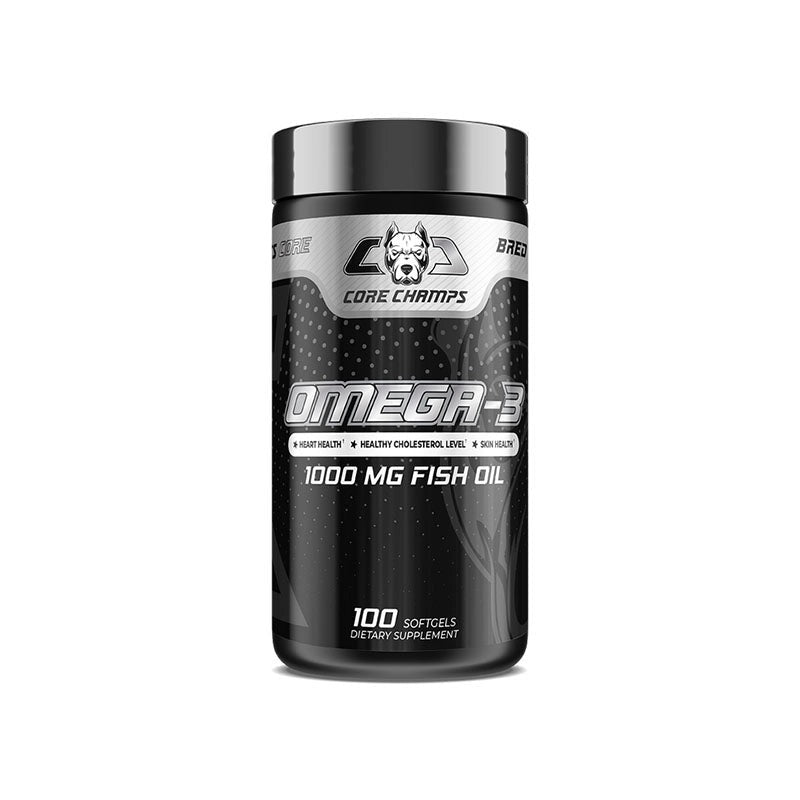
Core Champs Omega-3 Fish Oil
Core Champs contains 1000mg fish oil per softgel with 360mg EPA and 240mg DHA, giving 600mg EPA+DHA per softgel.
The current Vitamins House product directions state two softgels daily with meals.
Core Champs Omega-3 Fish Oil
Best for: Concentrated EPA + DHA
Pack: 100 Softgels
Price: Rs5,000
Buy NowNature's Bounty Fish Oil 1000mg
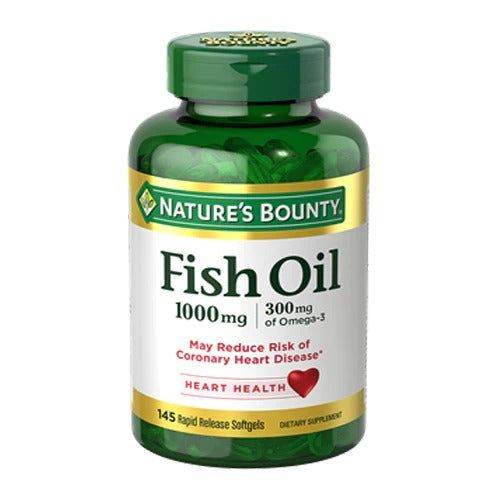
Nature's Bounty provides a useful example of a traditional-strength fish oil product.
Each softgel contains:
- 1000mg Fish Oil
- 300mg Total Omega-3
The manufacturer directions state that adults take one softgel three times daily, preferably with meals.
Nature's Bounty Fish Oil 1000mg
Best for: Standard everyday fish oil
Pack: 145 Softgels
Price: Rs7,641
Buy NowGNC Triple Strength Fish Oil
GNC Triple Strength demonstrates how a concentrated product can provide much more EPA+DHA in a single softgel.
The current GNC formula provides:
- 734mg EPA
- 266mg DHA
- 1000mg Total EPA + DHA
The current GNC manufacturer directions state one softgel daily with food.

GNC Triple Strength Fish Oil
Best for: High-potency EPA + DHA
Pack: 60 Softgels
Price: Rs14,999
Buy NowWhy Product Directions Can Be Different
Different products use different concentrations.
One manufacturer might recommend three standard-strength capsules, while another might provide a similar amount of Omega-3 in one concentrated softgel.
That does not mean one manufacturer is necessarily recommending a "higher dose."
The actual comparison should be based on:
- EPA per serving
- DHA per serving
- Total EPA+DHA
- Number of capsules
This is also why you should not copy the serving size from one fish oil brand and apply it to another.
Should You Take the Serving Printed on the Bottle?
For ordinary dietary supplement use, the manufacturer's current directions are the appropriate starting point unless your healthcare professional recommends something different.
Do not automatically:
- Double the serving because you want faster results
- Copy another brand's dosage
- Use prescription Omega-3 doses as a supplement target
- Assume more capsules mean greater health benefits
If you are uncertain about which strength to choose in the first place, our guide to choosing fish oil supplements in Pakistan explains concentration, serving size and other buying factors.
How Does Fish Oil Dosage Affect Price?
A bottle with 100 capsules is not necessarily a 100-day supply.
If the manufacturer's serving is:
1 capsule per day, a 100-count bottle may last around 100 days.
If the serving is:
2 capsules per day, the same bottle may last around 50 days.
If the serving is:
3 capsules per day, it may last only around 33 days.
So when comparing cost, look at:
| Factor | Why It Matters |
|---|---|
| Bottle Price | Upfront purchase cost |
| Capsules Per Bottle | Total pack size |
| Capsules Per Day | How long the bottle may last |
| EPA + DHA Per Serving | Actual Omega-3 concentration |
Our Omega 3 fish oil price in Pakistan comparison goes further by comparing bottle price, price per softgel and value relative to Omega-3 concentration.
Common Fish Oil Dosage Mistakes
Mistake 1: Treating 1000mg Fish Oil as 1000mg Omega-3
Total fish oil and EPA+DHA are not the same measurement.
Mistake 2: Counting Capsules Without Checking Strength
One concentrated softgel may provide more Omega-3 than three lower-strength capsules.
Mistake 3: Ignoring Serving Size
The supplement facts may be based on one, two or more capsules.
Mistake 4: Copying a Prescription Dose
Prescription Omega-3 used for high triglycerides should not be recreated using ordinary supplements without medical supervision.
Mistake 5: Assuming the Safety Limit Is the Recommended Dose
A regulatory safety ceiling is not a daily intake target.
Mistake 6: Ignoring Your Diet
Your total Omega-3 intake includes food as well as supplements.
Mistake 7: Increasing the Dose Without Checking Medication Interactions
Higher-dose Omega-3 may be inappropriate alongside certain medicines or medical conditions.
Frequently Asked Questions About Fish Oil Dosage
How much fish oil should I take per day?
There is no universal fish oil dose suitable for everyone. The amount of total fish oil is also less useful than the amount of EPA and DHA provided. Follow the current product directions and consider your diet and health circumstances.
How much EPA and DHA should I take daily?
The Institute of Medicine has not established a specific universal daily intake recommendation for EPA and DHA for healthy adults. Recommendations can differ depending on diet, cardiovascular status and medical use.
Is 1000mg fish oil enough per day?
The number 1000mg describes total fish oil and does not tell you how much EPA and DHA it contains. One 1000mg product may provide 300mg EPA+DHA while another provides 600mg or more.
Can I take 2000mg fish oil every day?
That depends on what the 2000mg actually contains, the manufacturer's directions and your individual health circumstances. 2000mg total fish oil is not the same as 2000mg EPA+DHA.
Can I take two fish oil capsules per day?
Only if that matches the directions for the specific product or advice from your healthcare professional. Two capsules of one product can provide a very different Omega-3 amount from two capsules of another.
Is 3000mg fish oil too much?
The total fish oil weight alone cannot answer this question because the EPA and DHA concentration varies. High-dose supplementation should be discussed with a healthcare professional, particularly if you take medication or have cardiovascular conditions.
Is 4 grams of Omega-3 safe?
Four grams per day is used in certain prescription Omega-3 treatments for high triglycerides under medical supervision. It should not be treated as a general daily supplement dose.
What is the maximum amount of Omega-3 per day?
The NIH reports that the FDA considers up to 5 grams per day of EPA+DHA from dietary supplements safe when used as recommended. This is a safety ceiling, not a recommended intake target, and higher doses can require medical supervision.
Should fish oil be taken with food?
Many manufacturers recommend taking fish oil with meals or food. Always follow the directions printed on the specific product you use.
How do I calculate my EPA and DHA dosage?
Find the EPA and DHA amounts on the Supplement Facts panel, add them together, then multiply by the number of capsules in your daily serving.
Should I take fish oil if I already eat fish?
Not necessarily. Your dietary fish intake contributes EPA and DHA. Whether supplementation is useful depends on your overall diet and individual nutritional needs.
What fish oil dosage is best in Pakistan?
There is no Pakistan-specific universal dose that applies to everyone. Choose based on EPA+DHA concentration, serving size, your normal diet and appropriate professional advice rather than simply selecting the largest fish oil number.
How to Choose the Right Fish Oil Dosage
The best approach is not to begin with a number such as 1000mg or 2000mg.
Start with the label.
- Check the serving size.
- Check how much EPA is provided.
- Check how much DHA is provided.
- Add EPA + DHA.
- Check how often the manufacturer recommends taking it.
- Consider how much oily fish you normally eat.
- Check medicines and health conditions before using higher doses.
For ordinary supplementation, follow the manufacturer's directions rather than copying a dosage from another brand.
For diagnosed conditions such as high triglycerides or established cardiovascular disease, discuss EPA and DHA intake with a qualified healthcare professional because medical Omega-3 doses can be very different from ordinary dietary supplementation.
If you are comparing formulas before deciding what to buy, browse the complete range of fish oil supplements in Pakistan at Vitamins House and compare EPA, DHA, concentration, serving size and pack size rather than choosing by fish oil milligrams alone.

