

Best Time to Take Fish Oil: Morning or Night, With or Without Food?

Should you take fish oil in the morning or at night?
What about breakfast, lunch or dinner?
And does fish oil need to be taken with food?
These are common questions, but there is one important thing to understand first:
There is currently no established universal "best time" of day to take fish oil for everyone.
For most people, choosing a time that fits your routine and following the directions for your specific supplement is more important than taking the capsule at a precise hour.
Food can matter, though.
Research on Omega-3 absorption shows that some forms of EPA and DHA, particularly ethyl ester Omega-3 formulations, are absorbed better when consumed with a meal containing dietary fat.
Many fish oil manufacturers also specifically instruct users to take their capsules with meals.
So if you are wondering about the best time to take fish oil, this guide explains morning vs night, taking Omega-3 with food, splitting servings, fishy burps, absorption and how to build a routine you can actually follow consistently.
Best Time to Take Fish Oil: Quick Answer
| Question | Practical Answer |
|---|---|
| Morning or night? | Either can work. There is not enough evidence to declare one universally better. |
| With food or without food? | Taking fish oil with a meal is generally the more practical choice and is recommended by many manufacturers. |
| Breakfast or dinner? | Choose a regular meal that works with your product directions and routine. |
| Can I split the serving? | Possibly, if this fits the product directions. Do not exceed the recommended daily serving. |
| What matters most? | Correct EPA+DHA amount, following the label and consistent use. |
Is There Really a Best Time to Take Fish Oil?
There is currently not enough evidence to say that every person should take fish oil at a specific hour of the day.
A small human pilot study published in 2021 investigated fish oil-enriched food consumed at breakfast versus dinner.
The researchers found differences in serum fatty acid concentrations and triglyceride metabolism depending on when the fish oil was consumed.
However, the study involved only a small number of participants and was specifically described as a pilot study.
You can review the research through PubMed.
This makes the study interesting, but it is not enough to establish a rule that:
"Fish oil must be taken in the morning."
For ordinary supplementation, the more practical priorities are:
- Taking the correct serving
- Checking EPA and DHA content
- Following the manufacturer's directions
- Taking it with food when directed
- Choosing a routine you can maintain consistently
Fish Oil in the Morning vs Night
For most people, both morning and evening are reasonable options.
| Timing | Possible Advantage | Possible Drawback |
|---|---|---|
| Morning | Easy to combine with breakfast or morning supplements | May be inconvenient if you skip breakfast |
| Lunch | Can work well with a substantial meal | Easier to forget when away from home |
| Evening | Convenient if dinner is your most consistent meal | Some people may dislike fishy reflux close to bedtime |
The best practical choice is often the meal you eat most reliably.
Is It Better to Take Fish Oil in the Morning?
Morning can be a convenient time, especially if you regularly eat breakfast.
Advantages may include:
- Easy integration into a morning supplement routine
- Taking the capsule with breakfast rather than on an empty stomach
- Less chance of forgetting later in the day
There is some early research suggesting that time of day could influence Omega-3 metabolism, but current evidence is not strong enough to say that morning supplementation is universally superior.
So there is no need to move your fish oil to breakfast simply because you have heard that morning is the "correct" time.
Is It Better to Take Fish Oil at Night?
Taking fish oil at night can also be perfectly reasonable.
For many people, dinner is:
- The largest meal of the day
- A meal containing some dietary fat
- The easiest meal to remember consistently
If your supplement directions state that it should be taken with food, dinner may therefore be convenient.
However, people who experience fishy burps, reflux or heartburn may not want to take fish oil immediately before lying down.
Our detailed guide to fish oil side effects explains fishy burps, heartburn, nausea and other common tolerability issues.
Does Taking Fish Oil at Night Help You Sleep?
Omega-3 fatty acids have been studied in relation to sleep, but that does not establish that swallowing a fish oil capsule immediately before bedtime will make you sleep better.
Research examining Omega-3 status and sleep is different from evidence showing that a specific bedtime dose has an immediate sleep-inducing effect.
Fish oil should therefore not be treated like a sleeping tablet.
If you take it in the evening, do so because that timing fits your meal and routine—not because you expect an immediate sedative effect.
Should You Take Fish Oil With Food?
For many products, yes.
This is one of the more useful practical recommendations when discussing fish oil timing.
EPA and DHA are fats, and the way they are absorbed can depend partly on the chemical form of the Omega-3 and the meal consumed with it.
A scientific review indexed by PubMed explains that EPA and DHA from some ethyl ester formulations can be poorly absorbed when consumed without a meal containing dietary fat.
The meal stimulates digestive processes involved in breaking down and absorbing fats.
That does not mean every fish oil formulation responds identically to food, because Omega-3 supplements can come in different chemical forms.
But taking your supplement with a normal meal is a practical approach when the product label recommends it.
Fish Oil With Food vs Empty Stomach
| With a Meal | Empty Stomach | |
|---|---|---|
| Fits many manufacturer directions | Yes | Often no |
| Provides dietary fat for digestion | Potentially | Little or none |
| Suitable for some ethyl ester formulas | Generally preferable | May reduce absorption |
| Digestive tolerability | May suit some users | May suit others |
A small randomized trial comparing fish oil taken with milk, food, on an empty stomach or as frozen capsules did not find clear differences in adherence or self-reported adverse effects between the groups.
This shows why claims such as "taking fish oil with food completely prevents fishy burps" should be treated cautiously.
Taking it with food may be appropriate for absorption and product directions, but it does not guarantee that every user will avoid digestive symptoms.
What Kind of Food Should You Take Fish Oil With?
You do not need a special "fish oil meal."
A normal balanced meal that contains some fat can be a practical option.
Examples might include meals containing:
- Eggs
- Yogurt
- Milk
- Nuts or seeds
- Avocado
- Olive or other cooking oils
- Fish
- Chicken or meat as part of a balanced meal
The goal is not to eat a high-fat meal simply because you are taking fish oil.
Your overall diet still matters much more than designing an unusually fatty meal around one supplement.
Can You Take Fish Oil With Breakfast?
Yes, particularly if breakfast is a meal you eat consistently.
For example, a breakfast containing eggs, milk, yogurt, nuts or other dietary fat can provide a normal meal context for the supplement.
Breakfast may be especially convenient if you already take other daily supplements in the morning.
However, if breakfast for you is only tea or coffee, another meal may be more practical when your fish oil directions specify taking it with food.
Can You Take Fish Oil With Lunch?
Yes.
There is nothing inherently wrong with taking fish oil at lunch.
If lunch is your most regular substantial meal, it may actually be the easiest time for you to remember.
Consistency and following your product instructions matter more than trying to force the supplement into breakfast or dinner.
Can You Take Fish Oil With Dinner?
Yes.
Dinner is one of the most convenient options because it is often a substantial meal containing dietary fat.
Taking fish oil with dinner can make particular sense if:
- You skip breakfast
- You forget supplements during work hours
- Dinner is your most predictable meal
- Your manufacturer recommends taking the product with food
If evening fish oil consistently causes reflux or fishy burps when you lie down, an earlier meal may suit you better.
Should Fish Oil Be Taken Before or After a Meal?
For ordinary dietary supplements, it is usually more useful to follow the product's specific instructions than to focus on an exact number of minutes before or after eating.
If the manufacturer says:
"Take with meals"
take the capsule as part of your normal meal routine.
There is usually no reason to create a complicated schedule such as exactly 17 minutes before breakfast or 30 minutes after dinner.
Morning or Night: What Matters More?
Several factors are more important than the exact clock time.
1. EPA and DHA Content
The amount of actual EPA and DHA you receive is more useful than whether you take the capsule at 8 a.m. or 8 p.m.
If you are unsure what these numbers mean, see our EPA vs DHA guide.
2. Serving Size
One product may require one softgel while another may recommend multiple capsules.
3. Taking It Correctly
If your product says to take the supplement with meals, follow that direction.
4. Consistency
Choosing a routine you can maintain is more practical than constantly switching between breakfast, lunch and dinner looking for the "perfect" time.
5. Your Individual Tolerance
If fish oil causes reflux when taken late at night, another meal may be more comfortable.
Should You Split Your Fish Oil Dose?
Some fish oil products have a daily serving consisting of multiple softgels.
Depending on the manufacturer's instructions, these may sometimes be taken across meals rather than all at once.
For example, if a label recommends multiple capsules throughout the day, splitting them between meals may make the routine easier to follow.
However, do not divide or increase a serving in a way that conflicts with the directions for your particular product.
And remember:
Two capsules of one fish oil product can contain a completely different amount of EPA and DHA from two capsules of another.
Our fish oil dosage guide explains how to calculate the EPA+DHA amount in your actual daily serving.
Can You Take Fish Oil Once a Day?
Some concentrated products are designed around a smaller number of daily softgels, while traditional fish oil formulas may have directions involving several capsules.
The correct schedule depends on:
- EPA per softgel
- DHA per softgel
- Total Omega-3 concentration
- Serving size
- Manufacturer directions
Do not convert a three-capsule product into a one-capsule routine simply because another brand is taken once daily.
Why Fish Oil Strength Changes the Routine
Consider these two examples:
| Product | Fish Oil | EPA + DHA |
|---|---|---|
| Webber Naturals Omega-3 | 1000mg | 300mg |
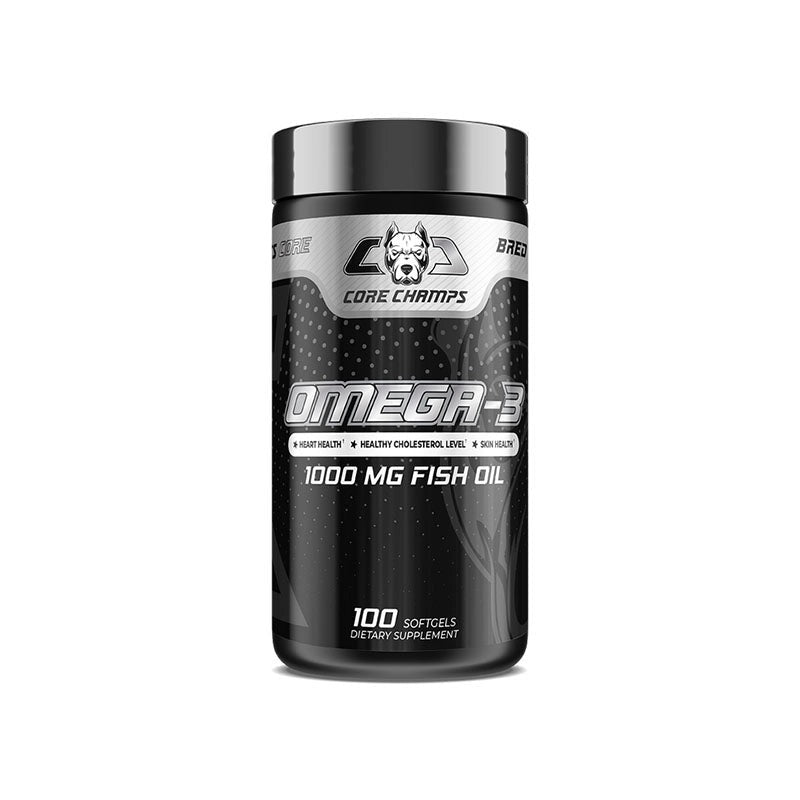
| Core Champs Omega-3 | 1000mg | 600mg |
Both say 1000mg fish oil, yet Core Champs provides twice the listed EPA+DHA per softgel.
This is why the article comparing 1000mg vs 1200mg vs triple strength fish oil focuses on actual Omega-3 concentration instead of the largest number printed on the front of the bottle.
Can Taking Fish Oil With Food Reduce Fishy Burps?
Some people find taking fish oil with meals more comfortable, and many product labels recommend doing so.
However, research specifically examining administration methods has not established a guaranteed method for preventing fish oil-related digestive symptoms.
If fishy burps are a major problem, you can also consider:
- A coated fish oil softgel
- An enteric-coated formulation
- A different Omega-3 concentration
- A product requiring fewer capsules
- Taking the supplement with a meal according to label directions
If symptoms remain troublesome, another product or a different Omega-3 source may be more appropriate.
Is It Okay to Take Fish Oil on an Empty Stomach?
Whether you technically can and whether it is the best way to take your particular supplement are different questions.
Fish oil does not automatically become dangerous because it was taken without food.
However, some Omega-3 forms—particularly ethyl ester concentrates—can have lower bioavailability when consumed without dietary fat.
Many manufacturers also explicitly recommend taking their products with meals.
For these reasons, taking fish oil with a normal meal is generally the more practical default unless your specific product instructs otherwise.
What If I Forget to Take Fish Oil?
If you occasionally forget your normal supplement time, do not automatically double your next serving.
Return to the directions on your product.
A supplement routine should not become:
"I missed yesterday, so I will take twice as much today."
Different products provide very different EPA and DHA concentrations, so doubling capsules can result in a much larger Omega-3 intake than expected.
Can You Take Fish Oil With Other Supplements?
Many people take fish oil as part of a wider supplement routine.
Whether it can be combined with another specific product depends on what that product contains and your individual circumstances.
Be particularly careful about unnecessarily combining multiple products that already contain Omega-3.
For example, someone might simultaneously use:
- Fish oil
- Cod liver oil
- An Omega 3-6-9 supplement
- A prenatal product containing DHA
That can make your total intake harder to calculate.
Check every Supplement Facts panel rather than assuming each product contains unrelated nutrients.
Can You Take Fish Oil With Vitamin D?
Fish oil and Vitamin D are sometimes included in the same supplement.
Nature's Bounty, for example, offers a Fish Oil + D3 formula containing both nutrients.
This means the combination itself is not unusual.
However, you should still consider your total Vitamin D intake from other supplements rather than unintentionally stacking several Vitamin D products.
Fish Oil vs Cod Liver Oil Timing
Fish oil and cod liver oil are both marine oils, but they are not nutritionally identical.
Cod liver oil naturally contains vitamins A and D in addition to Omega-3.
This means decisions about cod liver oil should also account for your total intake of those vitamins, particularly if you already take a multivitamin or separate Vitamin A or D supplement.
We will cover this distinction in detail in our dedicated fish oil vs cod liver oil comparison.
When Should You Take Fish Oil if You Get Acid Reflux?
If taking fish oil late in the evening repeatedly causes reflux or heartburn, consider whether another meal works better for you while remaining consistent with the product directions.
For example, you might find breakfast or lunch easier than taking the capsule close to bedtime.
Persistent or severe reflux should not simply be blamed on fish oil without appropriate medical evaluation, because heartburn has many possible causes.
When Should You Take Fish Oil if You Get Nausea?
Nausea is one of the mild side effects associated with Omega-3 supplements.
If you experience nausea, check:
- Whether you are following the serving directions
- Whether the product recommends taking it with meals
- How many capsules you take at once
- The EPA+DHA concentration
- Whether another supplement may also be contributing
If nausea persists or becomes significant, stop and seek appropriate professional advice rather than repeatedly changing or increasing the dose.
When Should You Take Fish Oil if You Take Medication?
Timing should not be used as a workaround for a potential medication interaction.
For example, taking a medicine in the morning and a high-dose Omega-3 supplement at night does not automatically eliminate an interaction.
The NIH Office of Dietary Supplements notes that Omega-3 supplements can interact with medications, including anticoagulants such as warfarin.
If you take prescription medication, particularly medicines affecting blood clotting, discuss fish oil use with your healthcare professional.
Fish Oil Products and Their Meal Directions
Real supplement labels illustrate why there is no single timing instruction that should be copied across every brand.
| Product | EPA + DHA / Omega-3 | Current Usage Direction |
|---|---|---|
| Webber Naturals Omega-3 1000mg | 300mg EPA+DHA | Adult directions specify use with meals |
| Core Champs Omega-3 | 600mg EPA+DHA | Current listing specifies use with meals |
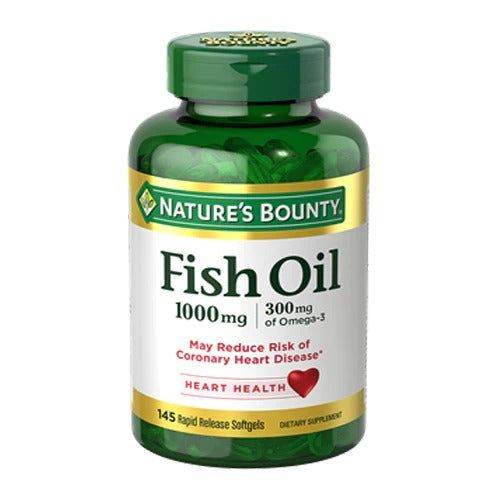
| Nature's Bounty Fish Oil 1000mg | 300mg Total Omega-3 | Preferably with meals |
This is why following your specific product directions is more useful than applying a generic social-media rule about taking fish oil at sunrise or immediately before bed.
Webber Naturals Omega-3 Fish Oil 1000mg
Webber Naturals provides a traditional fish oil formula containing 180mg EPA and 120mg DHA per softgel.
Its current adult directions specify taking the product with meals.

Webber Naturals Omega-3 Fish Oil 1000mg
Best for: Everyday EPA and DHA
Pack: 60 Softgels
Price: Rs3,990
Buy NowCore Champs Omega-3 Fish Oil
Core Champs contains 360mg EPA and 240mg DHA per softgel, providing 600mg combined EPA+DHA.
The current product listing instructs users to take the softgels with meals.
Core Champs Omega-3 Fish Oil
Best for: Concentrated EPA + DHA
Pack: 100 Softgels
Price: Rs5,000
Buy NowNature's Bounty Fish Oil 1000mg
Nature's Bounty Fish Oil provides 300mg total Omega-3 from 1000mg fish oil per softgel.
The current directions recommend taking the softgels preferably with meals.
The product is also coated to help minimise fishy aftertaste and burps.
Nature's Bounty Fish Oil 1000mg
Best for: Coated everyday fish oil
Pack: 145 Softgels
Price: Rs7,641
Buy NowWhat If Your Fish Oil Label Says Something Different?
Follow the directions on the specific product you actually purchased.
Formulas can change, and different products from the same brand may have different:
- EPA amounts
- DHA amounts
- Serving sizes
- Fish oil concentrations
- Suggested usage
Always check the physical bottle or current product information rather than assuming instructions from another fish oil supplement apply to yours.
Does It Matter If You Take Fish Oil at the Exact Same Time Every Day?
You generally do not need to take an ordinary nutritional fish oil supplement at exactly 8:03 a.m. every morning.
The more useful goal is establishing a consistent routine.
For example:
- With breakfast every day
- With lunch
- With your evening meal
Linking the supplement to an existing daily habit can make it easier to remember.
A Simple Fish Oil Timing Routine
For many people using an ordinary fish oil supplement, a practical routine can be as simple as:
- Read the serving directions.
- Choose a regular meal.
- Take the supplement with that meal when directed.
- Keep the timing consistent enough that you remember it.
- Do not double the serving after a missed day.
You do not need a complicated Omega-3 timing protocol.
Common Fish Oil Timing Mistakes
Mistake 1: Believing Morning Is Always Better
Early research on time-of-day effects is interesting, but it is not strong enough to establish morning as the universal best time.
Mistake 2: Believing Night Is Always Better
Fish oil is not a sleeping pill, and bedtime itself has not been established as universally superior.
Mistake 3: Ignoring the Meal Instructions
Many fish oil products specifically recommend taking their capsules with meals.
Mistake 4: Taking It With Only Coffee or Tea
If the label says to take it with food, a beverage alone is not the same thing as a meal.
Mistake 5: Doubling the Dose After Forgetting
Missing yesterday's serving does not automatically mean you should take twice the amount today.
Mistake 6: Ignoring EPA and DHA
Timing is much less useful if you do not know how much Omega-3 your supplement actually provides.
Mistake 7: Copying Another Brand's Routine
One product may be a standard 300mg EPA+DHA formula while another may provide 600mg or more per softgel.
How to Choose a Fish Oil Supplement That Fits Your Routine
Timing is easier when the supplement fits your lifestyle.
Before purchasing, consider:
- Number of softgels per serving
- EPA per serving
- DHA per serving
- Total EPA+DHA
- Whether it should be taken with meals
- Whether the softgel is coated
- Pack size
- Price
Our guide to choosing fish oil supplements in Pakistan covers these buying factors in more detail.
Frequently Asked Questions About When to Take Fish Oil
What is the best time to take fish oil?
There is no universally established best hour. For most people, taking fish oil with a regular meal according to the product directions and maintaining a consistent routine is more practical than focusing on morning versus night.
Should I take fish oil in the morning or at night?
Either can work. Current evidence is not strong enough to establish morning or evening as universally superior. Choose the meal and time that best fits your product instructions and routine.
Is it better to take fish oil with food?
Many fish oil manufacturers recommend taking their products with meals. Dietary fat can also improve absorption of certain Omega-3 formulations, particularly ethyl ester forms.
Can I take fish oil on an empty stomach?
Some people can tolerate fish oil without food, but certain Omega-3 formulations may be absorbed less efficiently without dietary fat, and many product labels specifically recommend use with meals.
Can I take Omega 3 before bed?
Yes, if evening supplementation fits your product directions and routine. However, people prone to reflux or fishy burps may prefer taking it earlier with another meal.
Does fish oil help you sleep if taken at night?
Omega-3 has been researched in relation to sleep, but there is not enough evidence to say that taking a fish oil capsule immediately before bedtime acts as a sleep aid.
Should I take fish oil before or after breakfast?
If your supplement says to take it with meals, taking it as part of breakfast is reasonable. There is generally no need to focus on an exact number of minutes before or after eating unless your specific product provides different instructions.
Can I take fish oil with dinner?
Yes. Dinner can be a convenient option, especially if it is your most regular meal. If evening fish oil repeatedly causes reflux, another meal may suit you better.
Can I split my fish oil capsules between morning and night?
If your product has a multi-capsule daily serving, splitting the serving may sometimes fit the directions. Check the specific label and do not exceed the recommended daily amount.
Can I take fish oil every day?
Many fish oil supplements are designed for regular use when taken according to their directions. Appropriate use depends on EPA+DHA concentration, diet, medicines and individual health circumstances.
Can I take fish oil with Vitamin D?
Fish oil and Vitamin D are sometimes included in the same supplement. However, check your total Vitamin D intake if you use several supplements.
Can I take fish oil with a multivitamin?
Many people combine them, but check the ingredients in both products. Some multivitamins or specialist formulas may already contain Omega-3 or other overlapping nutrients.
Does taking fish oil with food stop fishy burps?
Not necessarily. Some people may find meal-time use easier to tolerate, but studies have not established that taking fish oil with food completely prevents digestive side effects.
What meal is best for taking Omega 3?
A regular balanced meal containing some dietary fat is a practical choice, particularly when your product says to take it with food. You do not need an unusually high-fat meal.
Best Time to Take Fish Oil: The Bottom Line
The best time to take fish oil is usually the time you can take it correctly and consistently.
There is currently not enough evidence to say that everyone should take Omega-3 in the morning or that everyone should take it at night.
A better approach is:
- Read the product directions.
- Choose a regular meal.
- Take fish oil with food when the label recommends it.
- Check EPA and DHA rather than just total fish oil milligrams.
- Use a routine you can maintain.
If breakfast works best, take it with breakfast.
If dinner is your most reliable meal, dinner may be more practical.
If evening fish oil gives you reflux, try an earlier meal while staying within the product directions.
And remember that choosing the correct supplement and EPA+DHA concentration matters more than obsessing over the exact hour you swallow the capsule.
If you are still deciding which formula to buy, compare our guide to the best Omega 3 capsules in Pakistan or check the current Omega 3 fish oil prices in Pakistan.
You can also browse the complete range of fish oil supplements in Pakistan at Vitamins House and compare EPA, DHA, strength, pack size and current price before choosing.

